
A Practical Path Toward Safer and Higher-Energy Industrial Energy Storage Systems
1. Executive Summary
As the global energy transition accelerates, demand for higher-capacity and safer Energy Storage Systems (ESS) continues to grow across utility, commercial, and industrial applications. Conventional liquid-electrolyte lithium-ion batteries remain the dominant technology due to their mature supply chain, scalable manufacturing base, and well-established cost structure. However, system designers, integrators, and project developers continue to face two persistent challenges: safety under abuse or elevated-temperature conditions, and the difficulty of achieving further gains in system-level energy density without increasing design complexity.
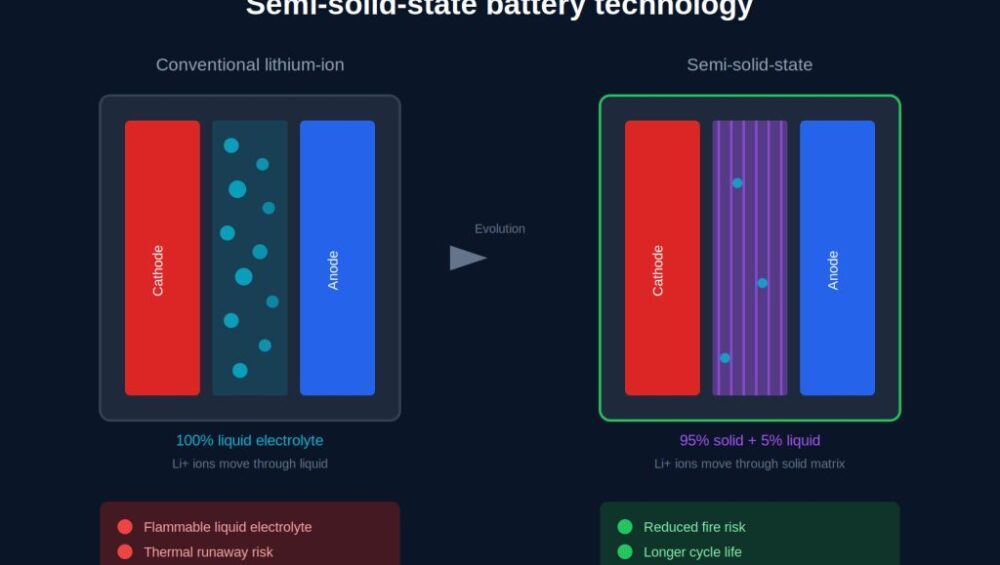
Semi-solid-state batteries are increasingly viewed as a practical intermediate step between conventional liquid lithium-ion batteries and fully solid-state batteries. By reducing the proportion of flammable liquid electrolyte and incorporating solid or gel-like ionic conduction media, semi-solid architectures aim to improve safety characteristics while enabling higher cell-level energy density. Just as importantly, many semi-solid approaches remain more compatible with existing lithium-ion manufacturing infrastructure than fully solid-state technologies.
This white paper outlines the technical rationale, production implications, and supply chain considerations behind the transition from liquid-electrolyte batteries to semi-solid-state batteries in industrial ESS applications. It is intended to help EPC firms, ESS integrators, battery manufacturers, and industrial buyers evaluate semi-solid-state technology from a practical commercialization perspective rather than from a purely laboratory standpoint.
2. Technical Context: Limitations of Conventional Liquid-Electrolyte Systems
Conventional lithium-ion batteries rely on organic liquid electrolytes to transport lithium ions between the cathode and anode. This architecture has supported the rapid growth of electric mobility and stationary storage, but it also introduces certain engineering limitations that become more critical as ESS projects scale in size and energy throughput.
2.1 Safety and Thermal Risk
Liquid electrolytes typically contain volatile and flammable organic solvents. Under abusive conditions such as overcharge, internal short circuit, mechanical damage, or severe overheating, these materials can contribute to gas generation, thermal instability, and, in extreme cases, thermal runaway. Elevated temperatures can accelerate side reactions, degrade interfacial stability, and increase the probability of failure propagation from cell to module or container level.
For ESS applications installed near industrial facilities, commercial sites, or urban infrastructure, safety is not only a cell-level issue but also a system-level design constraint involving thermal management, gas exhaust pathways, fire protection strategy, enclosure design, and regulatory compliance.
2.2 System-Level Energy Density Constraints
Although conventional liquid lithium-ion systems continue to improve at the cell level, system-level energy density gains are often moderated by the protective measures required to ensure safe operation. Cooling systems, spacing requirements, reinforced pack structures, and additional protection hardware all add weight and volume. As a result, higher nominal cell energy density does not always translate into proportional gains at the container or installation level.
This is particularly relevant in large-scale ESS projects, where footprint efficiency, installation cost, and thermal management complexity can significantly influence total project economics.
3. The Semi-Solid-State Battery Value Proposition
Semi-solid-state batteries reduce, but do not necessarily eliminate, the liquid phase within the electrochemical system. Depending on the design route, they may use gel-like electrolytes, composite electrolytes, or hybrid systems combining solid ionic conductors with a limited amount of liquid electrolyte to improve interfacial contact and manufacturability.
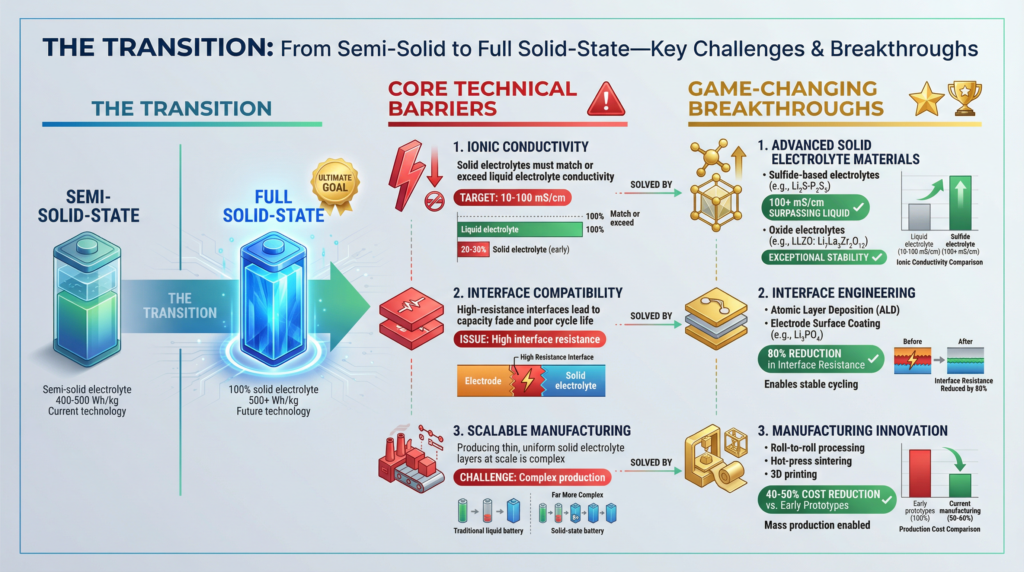
Rather than representing a complete departure from current lithium-ion technology, semi-solid-state batteries are better understood as an evolutionary platform that aims to balance improved safety, higher energy density, and feasible industrialization.
3.1 Improved Safety Characteristics
A key advantage of semi-solid-state battery design is the reduction of free flammable solvent content relative to conventional liquid-electrolyte cells. In principle, this can reduce the intensity of thermal events, delay exothermic reactions, and lower the likelihood of open-flame failure under certain abuse conditions.
In practical terms, semi-solid-state cells may demonstrate:
- lower flammability risk at the cell level,
- reduced gas evolution under some abuse scenarios,
- improved thermal tolerance depending on electrolyte formulation,
- lower dependence on highly reactive liquid environments.
That said, semi-solid-state systems should not be described as inherently nonflammable or risk-free. In many commercial or near-commercial architectures, some liquid or quasi-liquid components remain present. Accordingly, semi-solid-state chemistry should be viewed as a meaningful safety enhancement rather than a complete replacement for system-level fire protection, thermal propagation control, and ESS safety engineering.
3.2 Potential for Higher Cell-Level Energy Density
Semi-solid-state batteries are also attractive because they may support higher cell-level energy density than conventional liquid-electrolyte LFP systems, particularly when paired with high-nickel cathodes, advanced silicon-containing anodes, or other next-generation electrode materials.
From a market perspective, semi-solid-state technology is often discussed as a pathway toward cell energy densities above the range typically associated with mainstream LFP systems, while avoiding some of the manufacturing and materials challenges associated with fully solid-state batteries. Actual performance, however, depends heavily on the specific chemistry, electrolyte composition, electrode loading, packaging method, and operating conditions.
The value proposition for ESS is therefore not simply “maximum gravimetric energy density,” but a broader balance of:
- improved safety profile,
- higher usable energy per footprint,
- manageable manufacturing transition,
- more realistic near-term commercialization potential.
4. Indicative Performance Comparison
The following comparison is intended as a directional industry reference rather than a universal specification. Actual values vary by manufacturer, chemistry, cell format, test conditions, and application design.
| Metric | Standard LFP (Liquid) | High-Nickel NCM (Liquid) | Semi-Solid-State (Advanced Hybrid Chemistry) |
|---|---|---|---|
| Typical Cell Energy Density | 160–180 Wh/kg | 240–260 Wh/kg | 280–350 Wh/kg* |
| Typical Operating Temperature Window | Application-dependent | Application-dependent | Potentially wider, formulation-dependent |
| Cycle Life to 80% SOH | 4,000–6,000 | 2,000–3,000 | 3,000–5,000* |
| Safety Profile | Moderate | Relatively lower under abuse conditions | Potentially improved |
| Manufacturing Maturity | Very high | High | Emerging to early-commercial |
*Performance ranges are technology-route dependent and should be validated against specific supplier data, test protocols, and integration requirements.
This comparison highlights why semi-solid-state batteries are receiving increased attention from industrial stakeholders: they may offer a more favorable balance between safety and energy density than existing high-energy liquid systems, while remaining closer to commercial deployment than fully solid-state alternatives.
5. Manufacturing Integration and Industrialization Feasibility
For battery manufacturers and factory decision-makers, a major question is not whether semi-solid-state batteries are technically promising, but whether they can be adopted without disruptive reinvestment in entirely new production infrastructure.
5.1 Compatibility with Existing Lithium-Ion Production
One of the strongest industrial arguments in favor of semi-solid-state batteries is that many production steps remain related to current lithium-ion manufacturing logic. Depending on the design approach, manufacturers may still leverage a substantial share of existing capabilities in:
- electrode preparation,
- slurry processing,
- coating and drying,
- calendering,
- cell assembly,
- formation and testing.
The most significant changes often arise in electrolyte formulation, handling, infiltration, interface engineering, and in some cases coating or lamination processes. This is materially different from fully solid-state battery routes that may require more radical changes in materials handling, densification, interfacial engineering, and equipment architecture.
5.2 Capital Expenditure Considerations
For established battery manufacturers, semi-solid-state technology may present a lower-capital transition path than all-solid-state battery platforms. Instead of replacing entire production systems, many factories may be able to pursue phased upgrades, pilot-line validation, and selective process retrofits.
This does not mean the transition is simple or low-risk. Challenges remain in process stability, interfacial consistency, material dispersion, moisture control, quality assurance, and scale-up repeatability. However, from a factory economics perspective, semi-solid-state production may be substantially more approachable than laboratory-stage solid-state concepts that depend on entirely new processing ecosystems.
6. BMS and System Control Implications
A change in cell chemistry and internal architecture inevitably affects Battery Management System design. Semi-solid-state cells may exhibit different impedance behavior, polarization response, thermal characteristics, and voltage-response profiles compared with conventional liquid-electrolyte lithium-ion cells.
As a result, ESS developers should expect the need for updated BMS parameterization in areas such as:
- SoC estimation,
- SoH tracking,
- thermal behavior modeling,
- charge/discharge limit control,
- fault detection thresholds,
- fast transient response analysis.
In some applications, model-based estimation methods may be more important than with standard liquid-electrolyte systems, particularly where the voltage curve is less linear or where impedance behavior changes across temperature and aging conditions. BMS tuning should therefore be treated as a key part of semi-solid-state commercialization rather than as a minor software adjustment.
For industrial ESS projects, this also means that semi-solid-state adoption is not only a cell procurement decision. It is a system engineering decision involving integration between cell behavior, pack architecture, thermal strategy, inverter coordination, and operational control logic.
7. Upstream Supply Chain and Sourcing Implications
The transition toward semi-solid-state battery technology may alter procurement priorities across the upstream battery value chain.
7.1 Electrolyte and Conductive Material Demand
Semi-solid-state routes may increase demand for advanced electrolyte systems, including hybrid polymer, oxide-based, sulfide-based, or other composite ionic conductor materials. The exact sourcing impact will vary by chemistry platform, but materials qualification and supply consistency are likely to become more important than in conventional liquid-electrolyte procurement.
7.2 Electrode Material Evolution
Semi-solid-state platforms are often discussed together with more advanced cathode and anode systems, including high-nickel cathodes and higher-silicon-content anodes. These combinations may help unlock higher energy density, but they also raise requirements around interface stability, swelling control, cycle retention, and quality consistency.
7.3 Recycling and End-of-Life Considerations
Semi-solid-state batteries may offer potential advantages in end-of-life handling by reducing the proportion of free liquid electrolyte in some system designs. However, recyclability should not be overstated. Real-world recycling efficiency will still depend on electrolyte composition, binder systems, electrode chemistry, pack design, and the maturity of local recovery infrastructure. For B2B stakeholders, this should be treated as an area for future optimization rather than as an already-solved advantage.
8. Commercial Relevance for ESS Stakeholders
For EPC contractors, system integrators, industrial end users, and project developers, semi-solid-state batteries are relevant not because they represent a perfect technology, but because they may offer a commercially realistic improvement path.
From an ESS deployment perspective, semi-solid-state batteries may help address several recurring market needs:
- safer energy storage for projects located near populated or sensitive areas,
- improved energy density for space-constrained installations,
- reduced reliance on extreme cooling or overengineered protection margins,
- a more practical technology transition than fully solid-state systems,
- a clearer near-term route to differentiated ESS performance.
The commercial appeal lies in risk reduction through incremental innovation. Semi-solid-state technology is not yet a universal replacement for mature liquid-electrolyte lithium-ion systems, especially in cost-sensitive applications. However, it increasingly appears to be one of the most credible pathways for organizations seeking better safety-performance balance without waiting for fully solid-state batteries to achieve large-scale industrial readiness.
9. Conclusion
Semi-solid-state batteries should be understood as a practical transition technology rather than a speculative end-state solution. They do not eliminate all safety risks, nor do they immediately solve every limitation of conventional lithium-ion systems. However, they do offer a compelling combination of improved safety potential, higher energy-density opportunity, and more realistic manufacturing scalability than many fully solid-state concepts.
For industrial ESS stakeholders, the question is no longer whether semi-solid-state batteries are technically interesting. The more relevant question is where they can deliver measurable value first: in applications where safety margins, footprint efficiency, and differentiated performance justify a move beyond standard liquid-electrolyte architectures.
Organizations that begin evaluating semi-solid-state readiness now — from cell sourcing and BMS adaptation to supply chain qualification and factory process compatibility — will be better positioned to make informed decisions as the technology moves from early commercialization toward broader industrial deployment.
About the Author
This white paper was developed by our Technical Engineering Team to support industrial buyers, project developers, and ESS decision-makers in evaluating emerging battery technologies from a practical engineering and commercialization perspective. For detailed cell specifications, technical consultation, or factory assessment support, please contact our technical department.
