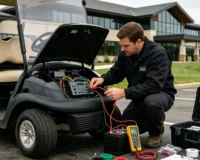
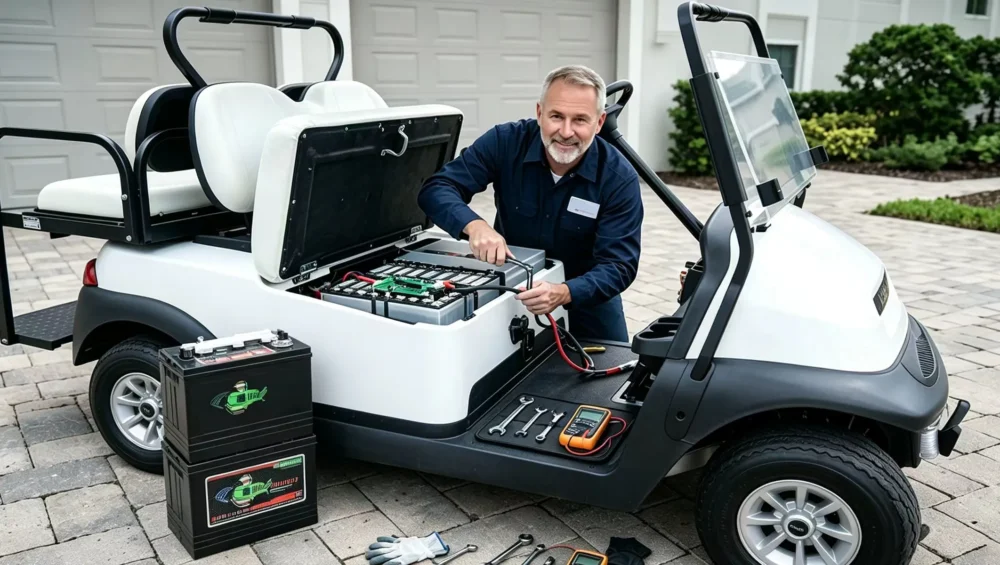
Replacing the lead-acid battery in the golf cart with a lithium battery reduces the overall vehicle weight and extends the battery’s lifespan. Additionally, it delivers greater power, longer range, faster charging, and enhanced safety. Unlike lead-acid batteries, which require regular distilled water top-ups for maintenance, upgrading to a lithium battery is an optimal choice for frequent users in terms of both usage cost and performance.
Comparison Between Lead-acid Battery and Lithium Battery Cores
| Key Performance Metrics | Flooded Lead-Acid Batteries | LiFePO4 Lithium Batteries | Direct Performance Impact |
| Service Lifespan | 300 – 500 charge cycles | 3,000 – 5,000+ charge cycles | Up to 10x longer lasting |
| Physical Weight | 350 – 450 lbs (average pack) | 70 – 150 lbs (average pack) | Less turf compaction, higher speed |
| Electrolyte Maintenance | Regular distilled water top-offs | Maintenance-free solid construction | Zero corrosion, no acid leaks |
| Usable Capacity (DoD) | 50% Safe Depth of Discharge | 100% Depth of Discharge | Twice the runtime per rated Ah |
| Voltage Sag | Drops as battery drains (slows down) | Flat discharge curve (full power always) | Consistent speed even on steep hills |
How to Choose Lithium Batteries Suitable for Golf Carts
When choosing lithium batteries, the prerequisite for golf cart distributors and golf cart repair shops is to confirm whether the battery installation space is suitable, followed by confirming the three core parameters of battery voltage, capacity, and current to avoid installation mismatch caused by inconsistent models.
Matching voltage: 36V and 48V
The battery voltage of golf carts on the market is mainly divided into 36V and 48V. Therefore, golf cart distributors and golf cart repair shops only need these two voltages when purchasing. It should be noted that 36V and 48V cannot be confused, otherwise it is very easy to burn out the components.
- 6V battery: 6 pieces are connected in series to form a 36V system, and 36V lithium batteries can be directly purchased
- 8V battery: 6 pieces connected in series to form a 48V system, compatible with 48V lithium batteries
- 12V battery: 4 pieces connected in series to form a 48V system, also using 48V lithium batteries
The battery capacity determines the range, and the range of different battery capacities is as follows:
- 50Ah-60Ah: Suitable for flat roads and short distance driving, with a range of about 15-20 miles
- 105Ah: Suitable for bumpy roads and outdoor off-road use, with a range of about 30-40 miles
- 150Ah-160Ah: suitable for daily long-distance travel, with a range of 50-65 miles
Suggestions for current selection:
Choosing lithium batteries not only depends on voltage and capacity, but also on current, which plays a protective role.
- Regular version golf cart: choose batteries with discharge of 100A or above
- Modified golf cart, 8 seater golf cart, 10 seater golf cart: prioritize 150A-200A continuous discharge specifications
Lithium battery installation tools and materials
- Safety protective equipment: anti slip insulated gloves, goggles, baking soda (used to neutralize residual battery acid)
- Manual tools: insulated socket wrench, wire cleaning brush, heavy-duty wire clamp
- Supporting consumables: large-sized battery specific cables, anti rust grease for terminal blocks, high-strength zip ties, battery fixing shock pads, etc. These tools are common items in hardware stores and easy to purchase.
Complete Installation Steps for Lead-acid to Lithium Batteries in Golf Carts
Step 1: Turn off the power and remove the key
Parking the golf cart on a flat surface and tightening the handbrake is crucial to prevent the cart from slipping.
Step 2: Disassemble the old lead-acid battery
- First, remove the negative electrode connecting wire of the battery
- Dismantle the positive connecting wire again
- Then remove the series wires between the battery packs
- Finally, remove the battery mounting bracket and take out the batteries one by one
Step 3: Clean the battery compartment with water
The battery compartment contains a large amount of rust, dirt, and battery acid, so it must be thoroughly cleaned before installing new batteries, dried naturally, and sprayed with anti rust primer to avoid subsequent rusting.
Step 4: Special modification for Club Car models
This step is only applicable to the Pioneer and DS Club Car models. The original car is equipped with an on-board charging control system designed specifically for lead-acid batteries, which may limit the normal operation of the lithium battery dedicated charger and must be bypassed
- Find the wiring harness of the onboard computer
- Connect the blue and white lines and lift the charging permission restriction
- After directly connecting the negative terminal of the charging socket to the grounding terminal of the controller, the original vehicle charging control can be completely disconnected, and the lithium battery charger can be used normally.
Step 5: Fixed installation of lithium battery pack
Place the club car lithium batteries in the battery compartment one by one, and place the integrated battery pack directly into it; The installation manual for split type battery packs requires placement. If there is a spare position, it can be filled with damping foam to avoid shaking or displacement of the battery during driving. Finally, fix the bracket.
Step 6: Install a voltage converter
The wiring principle follows the principle of connecting the negative pole first and then the positive pole. If you want to take electricity from a single battery to power devices such as car lights and speakers, it is not possible, which can shorten the battery life. Professional practice: Install voltage converters, 36V to 12V converters, and 48V to 12V converters to ensure balanced discharge of the battery.
Step 7: Fully charged debugging
It is recommended to fully charge the battery for the first time. Please use a lithium battery specific charger. It is forbidden to use a charger with lead-acid batteries, as incorrect charger parameters can shorten the battery life.
Precautions for Low-temperature Use and Storage of Lithium Batteries
The most taboo thing about club car lithium batteries is charging below zero degrees Celsius, which not only shortens the rated capacity of the battery, but also leads to a shortened battery life. Winter charging and usage guidelines:
- Try to keep the golf cart indoors and charge it during winter
- Long term non use, it is recommended to charge the battery to around 80% to slow down battery aging
FAQ
Can old lead-acid chargers charge lithium batteries?
No, the voltage and current of the two chargers are different, and mixing them will shorten the battery life.
Do I need to replace the original car controller synchronously when replacing the lithium battery?
The prerequisite is to ensure that the voltage of your controller is consistent with the voltage of the lithium battery in order to ensure consistent current output, avoid full load, and provide power-off protection during long-term driving.
How to store lithium batteries that have been idle for a long time in winter?
It is recommended to store it indoors with the battery fully charged to around 80%.
Can lithium batteries be charged in low temperature weather?
Sure, but it’s best to place it indoors for faster charging.
Do external lighting and audio devices need to be equipped with voltage converters?
Yes, a dedicated voltage converter is a standard accessory for peripheral power consumption.
Summary
Many electric club cars can operate normally, but their slow acceleration, slow charging, and high maintenance costs greatly affect the user experience. Upgrading lightweight and longer range lithium batteries not only improves vehicle performance but also reduces maintenance costs. According to this article, battery upgrade and installation will be carried out. After the upgrade is completed, the starting response of the ball car will be more sensitive, the body will be lighter, and daily use will be worry free and cost-effective.