The function of the golf cart speed controller is to transmit the energy released by the battery to the motor for driving, ensuring the golf cart moves steadily at a set speed. In addition to controlling the motor’s rotation speed and direction, the golf cart speed controller also has other functions. This article will specifically elaborate on the specific functions of the golf cart speed controller.
The Main Functions of the Golf Cart Speed Controller
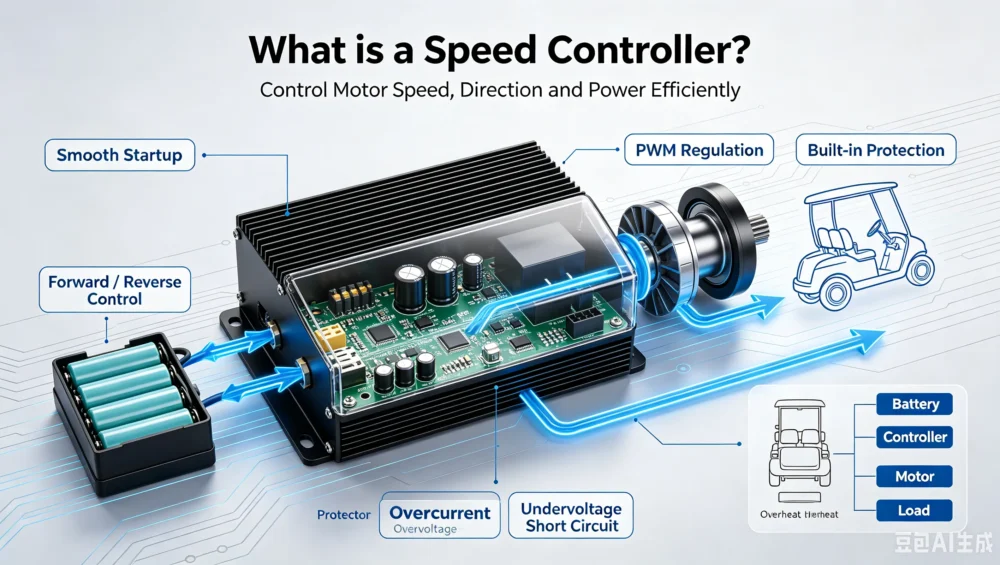
Smooth startup
The three core components of a golf cart: battery, motor, and controller, are indispensable. The battery supplies energy, the controller manages power transmission, and the motor converts energy into motion. This ensures the golf cart starts smoothly. If the battery directly delivers electricity to the motor, the motor’s torque would surge instantly, potentially damaging the internal gears and casing.
Forward and Reverse Control
When driving a golf cart and needing to reverse on a narrow road where U-turns are impossible, the controller can manage the motor’s forward and reverse rotation.
Reverse Power Supply Protection
If the user mistakenly connects the battery terminals in reverse, the controller can automatically provide protection to prevent electronic components from burning out.
Circuit fault protection
The controller features built-in protection functions against overheating, overvoltage, overcurrent, short circuits, and reverse polarity.
How does the Golf Cart Speed Controller Work?
Golf Cart Speed Controller commonly uses PWM technology, which aims to achieve balanced voltage for the motor. For example, if a 48V battery is connected 50% of the time and disconnected 50% of the time, the actual average voltage of the motor is 24V, so the motor will run at half the speed.
The motor current always flows continuously, while the battery current varies according to the PWM duty cycle. For example, if the PWM duty cycle is 50%, the motor current may be 100A, and the actual output of the battery is about 50A.
Why is PWM Efficiency so High?
It will be easier for me to understand here by comparing with numerical values. The formula is: power=voltage * current.
Battery: 48V * 100A=4800W
After PWM adjustment
Motor: 24V * 200A=4800W
That is to say, the motor obtains all the energy from the battery, and the controller plays a crucial role in the middle.
Why do We Need a Motor Speed Controller?
Overall, for safety reasons, high-power motors have a large output current and require the use of professional motor speed controllers. for example
Golf cart
- Electric forklift
- High altitude work platform
- Floor scrubber
- Weeding machine
- Electric scooters
- Electric vehicles
Is VFD a Speed Controller?
Belonging to. VFD is mainly used for AC motors. Adjust the motor speed to ensure smooth start, stop, and acceleration of the golf cart.
What are the Main Ways to Control Motor Speed?
open-loop control
Open loop control only outputs control signals based on set values and is suitable for devices with small load changes. Features:
- Simple structure
- Low cost
- Average accuracy
- Not detecting the actual rotational speed
closed-loop control
Closed loop control utilizes encoders, Hall sensors, and other feedback to determine the actual speed of the motor. Controller constantly compares: actual speed ↔Target speed, then automatically adjust output. Advantages:
- More stable rotational speed
- Stronger full load capacity
- Higher control accuracy
Which Type of Motor is More Suitable for Speed Regulation?
- AC motor
- Brushless motor
- Permanent magnet synchronous motor
These motors have the following advantages
- Wide speed range
- High efficiency
- Fast response speed
- Low maintenance cost
What is the Speed Controller in Electric Vehicles?
The speed controller of electric vehicles is usually called ESC, which is responsible for:
- Control the motor speed
- Control the vehicle’s forward and backward movement
- Implement electronic braking
- Energy recovery (regenerative braking)
- Motor protection
Whether it’s a golf cart, electric scooter, or electric vehicle, the controller is the core component of the entire vehicle’s power system.
What are the Advantages of Using a Motor Speed Controller?
Energy saving
Accurately delivering the energy from the battery to the motor ensures maximum energy output and improves efficiency.
Precise speed control
The controller can accurately control the motor speed to ensure stable driving of the vehicle.
Extend lifespan
It can accurately control the electrical energy of the battery and the speed of the motor, reduce unnecessary consumption, lower the failure rate, and extend the service life.
Security protection
- Overcurrent protection
- Overvoltage protection
- Undervoltage protection
- Overheating protection
- Short circuit protection
Widely used devices
The controller can adjust parameters according to the needs of different application devices and is suitable for various vehicles and industrial equipment.