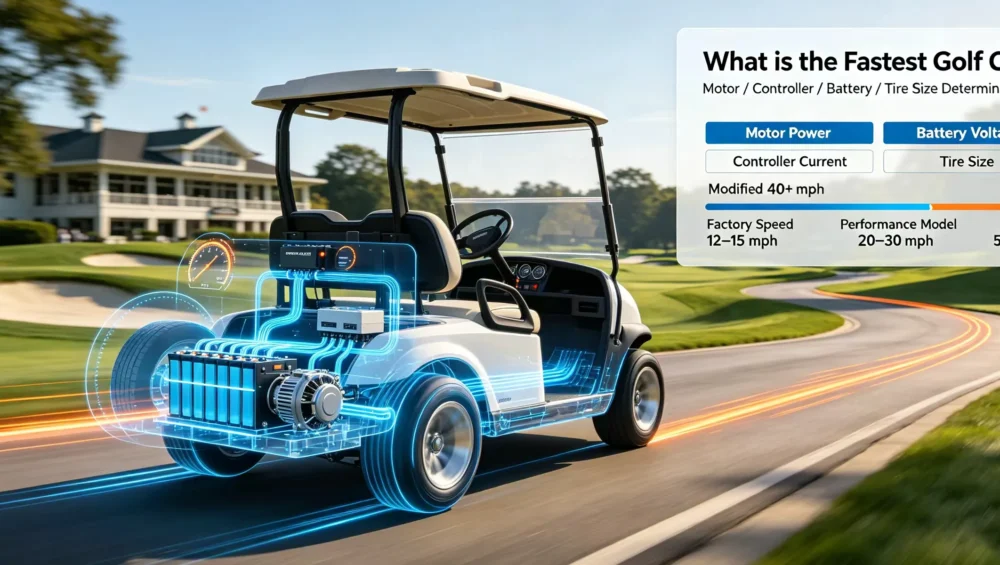
The speed of Electric golf carts is usually determined by factors such as the motor, controller, battery, tire size, etc. To improve speed, it is not just about upgrading a single component. The common speeds of golf carts on the market are as follows:
- EZGO, Club Car, Yamaha and other models typically have a factory speed of 12-15 mph.
- ICON, Evolution, Star EV and other high-performance models: 20-30 mph.
- Modified vehicle model: 40 mph+, usually using high-voltage and high current batteries and controllers, upgraded motor.
- Extreme racing modification: 50 mph or even higher, usually customized golf carts.
How Fast Can a Golf Cart Go?
Standard Golf Cart Speed
Original golf cart brands such as EZGO, Club Car, Yamaha, etc. typically have a speed of 12-15 mph. Usually equipped with 36V/48V batteries, low-power AC/DC motors, and original controllers, speed limits are set for safety reasons.
Modified Golf Cart Speed
Upgrade lead-acid batteries to lithium batteries, upgrade DC motors to AC motors or PMSM permanent magnet synchronous motors, and equip controllers with currents greater than 400A. After electric golf cart upgrade, The speed is usually between 20-40mph. For the fully loaded 8 seater golf cart and 10 seater golf cart, there is a significant improvement in climbing and load capacity.
Racing Golf Cart Speed
The speed is between 40-60 mph+, the battery voltage is usually greater than 72V, the controller current is 500A+, and the motor is usually a PMSM permanent magnet synchronous motor. In addition, corresponding upgrades need to be made to the tires, external structure, chassis, etc. of the golf cart to ensure safe and reliable high-speed driving.
What Determines Golf Cart Speed?
Motor Power Determines Acceleration
Motor power affects torque and climbing capability, playing a crucial role in long-duration operation and full-load climbing for 6-passenger golf carts, 8-person golf carts, and 10-person golf carts. The three commonly available motor types on the market—DC, AC, and PMSM—each have their advantages and disadvantages.
DC Motor:
Advantages: Affordable, suitable for low-end commuter cars and golf carts.
Disadvantages: short service life, high noise level, and weak climbing ability.
AC Motor:
Advantages: Long lifespan, low noise, higher load capacity, suitable for operational vehicles.
Disadvantages: high price and high maintenance costs.
PMSM Motor:
Advantages: High torque, rapid acceleration, strong climbing capability, minimal noise, and support for both lithium and lead-acid batteries.
Drawbacks: Higher cost and the need for a dedicated controller.
Golf Cart Controller Controls Power Output
The controller is responsible for transmitting the energy released by the battery to the motor for driving. The difference between the 350A and 500A controllers lies in the higher current output of the latter, which means faster acceleration, better climbing capability, and full-load capacity.
The PMSM PRO permanent magnet synchronous conversion kit independently developed by SPIDERWAY features a controller voltage range of 24-72V and a current range of 350A-550A, compatible with most golf carts and supporting upgrades for both lithium-ion and lead-acid batteries.
Battery Voltage Affects Maximum Speed
Common battery voltages include 36V, 48V, and 72V, while higher voltages require matching high-current controllers and high-torque motors.
Tire Size Changes Golf Cart Speed
Large-diameter tires can increase the distance traveled per motor rotation, thereby improving the top speed. However, larger tires also increase resistance and weight, so it is best to upgrade the motor and controller simultaneously.
Vehicle Weight Impacts Performance
The number of passengers and the weight of the cargo will affect the speed of the golf cart.
How to Make a Golf Cart Faster?
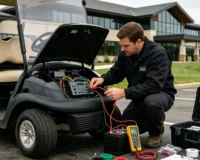
Upgrade the Golf Cart Controller
The factory-installed controller, for safety reasons, limits high current output to restrict speed. Upgrading to SPIDERWAY’s PMSM PRO modification kit, featuring a 4kW motor and 450A controller, significantly enhances current output and motor torque, improving starting acceleration and load capacity.
Upgrade to Lithium Battery
Lead-acid batteries are heavy, have a short lifespan, and offer limited range. Upgrading to lithium batteries results in lighter weight, longer range, and more stable voltage output.
Upgrade Motor System
AC Motor is suitable for the use and operation of most golf carts, whether in terms of load capacity or service life.
The PMSM motor is more suitable for 6-person golf carts and 8-passenger golf carts. It offers rapid acceleration and strong climbing performance when fully loaded.
Is a Faster Golf Cart Safe?
After upgrading the controller, motor, and battery, you’ll notice a significant speed improvement. For safety reasons, remember to upgrade your braking system, chassis, and tires to avoid situations like brake failure or tire blowouts at high speeds. Faster speeds mean higher demands on the vehicle’s safety systems.
FAQ
What is the fastest golf cart speed?
Most standard golf carts run at 12-15 mph, while modified performance golf carts can exceed 40 mph.
Can a golf cart go 50 mph?
Yes. However, it requires upgraded motor, battery and controller systems.
Does a golf cart controller increase speed?
A high-performance controller can increase current output and improve acceleration when properly matched with the motor and battery.
What voltage is best for a fast golf cart?
48V and 72V systems are commonly used for high-performance golf carts.
Can I replace my Curtis golf cart controller?
Yes. Many aftermarket controllers are designed as direct replacements for Curtis models.
Conclusion
Golf cart dealers, distributors, and OEM manufacturers often encounter customer requests for speed upgrades. However, it is unscientific to assume that upgrading just one component can achieve the desired speed improvement. The fastest golf cart is not determined by a single part—the true factors affecting speed are the motor, controller, battery, and vehicle design.