Even if you are not a golf cart distributor, golf cart repair shops. Understanding the basic faults of Club Cars and knowing how to repair them yourself can save unnecessary repair costs. In this article, I will provide a detailed description of common issues with Club Car and teach you how to troubleshoot them.
Why Your Club Car Electric Golf Cart Stops Working?
If you are a Club Car owner, you will definitely encounter problems such as unresponsive pedals, insufficient climbing power, sudden stops, and slow acceleration. There are many reasons why golf cars cannot drive normally, such as:
- Battery aging
- Line corrosion
- Controller damage
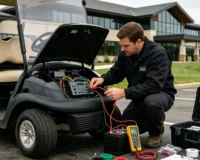
You can use a multimeter to quickly detect the golf cart controller, battery, contactor, etc., and troubleshoot them one by one.
Common Club Car Electric Golf Cart Problems
Club Car Golf Cart Won’t Move
- No response when turning on the power
- Stepping on the pedal, the golf cart does not move
If the controller is functioning properly, the battery cannot provide sufficient current and the golf cart cannot travel. Check the battery problem, check if each connecting wire of the battery is loose or aging, use a multimeter to check if the total voltage is normal and if the individual batteries are consistent. For example, the normal voltage of a 48V system is between 50-52V. If it is lower than the normal range, it indicates that the battery has a problem and needs to be repaired in a timely manner.
Solenoid Failure
Connect or disconnect the high current between the battery and the controller. Lightly press the pedal and hear a “Click” sound, indicating that the solenoid valve is in good condition; If no ‘Click’ sound is heard, it indicates that the solenoid valve is damaged.
Controller Failure
If the battery, wiring, and Solenoid are all normal, further investigation of the Club Car controller is required. Lightly step on the accelerator and observe whether the output voltage of the controller increases with the throttle? If the controller is functioning properly, the voltage will continue to increase. If the controller is abnormal and there is no response from the voltage, it indicates that the controller is damaged.
Club Car has Slow Speed or Weak Power
- Normal driving on flat roads
- Unable to climb uphill
- Slow acceleration
Battery Capacity Decline
If your golf cart battery has been used for a long time and cannot provide high current, it will cause the golf cart to have weak climbing and slow acceleration.
Controller Current Limitation
The battery is in good condition, but the controller cannot output high current, which can also lead to insufficient power and slow acceleration. If you want stronger power, you can upgrade the controller to 550A 48V, greatly improving the power.
Club Car Golf Cart Stops Suddenly
The long-term high load operation of the controller resulted in excessive stability, triggering the controller’s safety protection.
How to Troubleshoot Club Car Controller Step by Step
Firstly, check the battery voltage
Check whether the total voltage is normal and whether the individual batteries are consistent. For example, the normal voltage of a 72V system is between 74-76V. If it is lower than the normal range, it indicates that the battery has a problem and needs to be repaired in a timely manner.
Next, check the input voltage of the controller
After opening the key, measure whether the controller can receive voltage. If not, check the contactor, battery circuit connectors, etc.
Then check the contactor
Can you hear a ‘Click’ sound when lightly pressing the accelerator. Measure the input and output terminals of the contactor again. If there is power in the input and no power in the output, it indicates that the contactor may be damaged.
Re check the throttle signal
Lightly step on the accelerator and observe if the signal is stable. If the signal is not stable, it indicates a throttle malfunction.
Finally, check the output voltage of the controller
Lightly step on the accelerator and observe whether the output voltage of the controller increases with the throttle? If the controller is functioning properly, the voltage will continue to increase. If the controller is abnormal and there is no response from the voltage, it indicates that the controller is damaged.
Club Car DS vs Club Car Precedent Troubleshooting
Club Car DS Controller Problems
Features of Club Car DS: There are many old models and they have been in use for a long time.
Common problems: controller aging, corroded wiring, incompatible battery upgrades.
Club Car Precedent Controller Problems
Precedent: High market share.
Common problem: Controller malfunction.
FAQ
Q1: Why is my Club Car electric golf cart not moving?
- Battery failure: unable to provide sufficient current.
- Battery circuit disconnection: unable to output current.
- Electromagnetic valve malfunction: unable to connect battery and controller.
- Throttle malfunction: unable to transmit signal to controller.
- Controller malfunction: unable to deliver current to the motor.
Q2: How do I know if my Club Car controller is bad?
- Unable to move
- Slow acceleration
- Controller overheating
- Fault code error
Q3: Can I upgrade my Club Car controller?
Upgrading the controller can improve:
- Current output
- Acceleration
- Full load performance
- Stronger power output
Q4: Do I need a new controller after lithium conversion?
Depends on: Does the battery voltage match the controller.
Conclusion
The troubleshooting of Club Car electric golf cart requires a step-by-step inspection from simple to complex.
Firstly, confirm: Battery → Solenoid → Wiring → Controller. For Club Car DS, Club Car Precedent, and other electric golf ball models, selecting the correct controller specifications can improve:
- Power performance
- Stability
- Service life