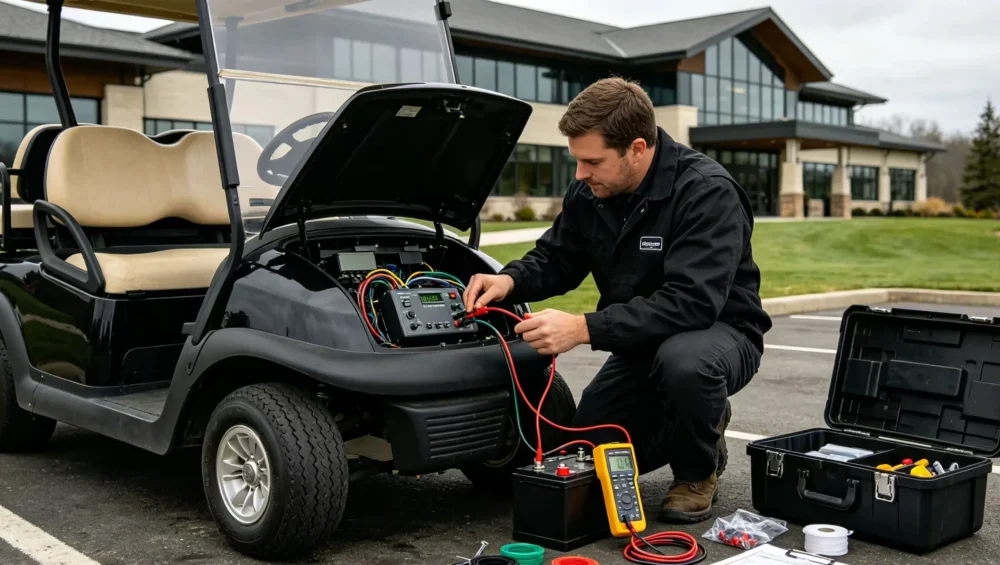
It’s quite normal for the golf cart not to move, as most core issues stem from three factors: the motor, battery, and controller. For example, battery degradation, controller protection activation, or motor malfunction. In this article, I’ll guide you on how to quickly identify the cause of the golf cart not moving and provide corresponding repair suggestions.
Why the Golf Cart Won’t Move?
To understand why the golf cart won’t move, one must first grasp its power system. Any malfunction in these components can cause the golf cart to stop moving.
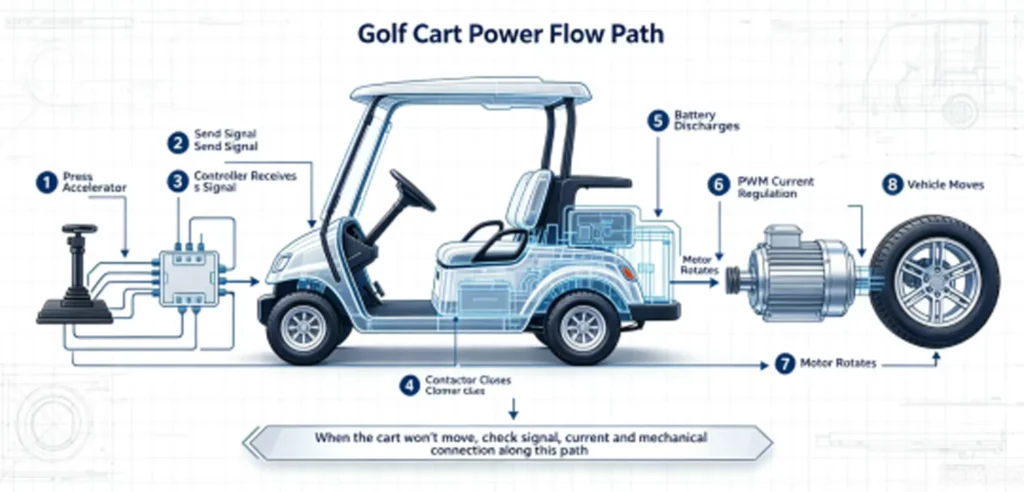
The driver presses the accelerator—The accelerator pedal sends a signal—The controller receives the signal—The contactor engages—The battery releases current—The controller PWM-regulates the output current—The motor rotates—The golf cart moves forward.
Top Six Common Reasons for Golf Cart Won’t Move
Low battery level or battery aging
Whether you are a lithium battery or a lead-acid battery, over time there will be problems such as insufficient voltage, bulging of the battery, loose connecting wires, and easy oxidation of fuses and connecting wires. You can use a multimeter to check if the battery voltage (36V, 48V, 72V) is normal.
Solenoid contactor malfunction
Lightly press the accelerator, you can hear the sound of “Click”, and the vehicle does not move. Measure the input and output terminals of the contactor again. If there is power in the input and no power in the output, it indicates that the contactor may be damaged. If you can’t hear the ‘Click’ sound, it’s obvious that the contactor is faulty, which can also cause the golf cart to won’t move.
controller failure
Usually manifested as inability to start, slow acceleration response, and fault codes. Can the measurement controller receive input voltage after the key is turned on? Lightly step on the accelerator and observe whether the output voltage of the controller increases with the throttle? If the controller is functioning properly, the voltage will continue to increase. If the controller is abnormal and there is no response from the voltage, it indicates that the controller is damaged. If you want to find a Curtis controller or upgrade to stronger power, you can choose the PMSM PRO retrofit kit.
Accelerator pedal malfunction
Lightly step on the accelerator and observe if the signal is stable. If the signal is not stable, it indicates a throttle malfunction. Usually manifested as a constant speed when the accelerator is pressed to the bottom.
Motor failure
Whether you are an AC, DC, or permanent magnet synchronous motor. Faults usually manifest as bearing damage, motor overheating, etc., which can also cause the golf cart to won’t move.
Brake system stuck
There are usually two types of braking systems: mechanical braking and electromagnetic braking. If your golf cart brake system gets stuck, the golf cart won’t move.
Electrical circuit damage
Including connectors, CAN wiring harnesses, and controllers, it is usually damaged due to humid environments, bumpy driving surfaces, and prolonged operation, resulting in short circuits. Resulting in the golf cart won’t move.
How to Use a Multimeter to Check the Controller of a Golf Cart?
Firstly, check the battery voltage
Check whether the total voltage is normal and whether the individual batteries are consistent. For example, the normal voltage of a 72V system is between 74-76V. If it is lower than the normal range, it indicates that the battery has a problem and needs to be repaired in a timely manner.
Next, check the input voltage of the controller
After opening the key, measure whether the controller can receive voltage. If not, check the contactor, battery circuit connectors, etc.
Then check the contactor
Can you hear a ‘Click’ sound when lightly pressing the accelerator. Measure the input and output terminals of the contactor again. If there is power in the input and no power in the output, it indicates that the contactor may be damaged.
Re check the throttle signal
Lightly step on the accelerator and observe if the signal is stable. If the signal is not stable, it indicates a throttle malfunction.
Finally, check the output voltage of the controller
Lightly step on the accelerator and observe whether the output voltage of the controller increases with the throttle? If the controller is functioning properly, the voltage will continue to increase. If the controller is abnormal and there is no response from the voltage, it indicates that the controller is damaged.
What faults can be Repaired by Oneself?
The battery port is detached, the fuse is detached, etc. can be repaired by oneself. If you need to replace the controller, battery, etc., it is recommended to seek professional assistance or visit the attached golf cart repair shops. Avoid short circuit faults caused by wiring errors.
When do I Need to Replace the Golf Cart Controller?
When your golf cart experiences the following situations, such as
- The car cannot start
- Starting with a jolt
- Unable to climb uphill with full load
- Controller overheating
- Acceleration delay
After upgrading the lithium battery and motor, there is still insufficient power
Suggest upgrading the SPIDERWAY PMSM PRO modification kit, which not only supports 24-96V 350A/550A lithium batteries, but also supports parameter adjustment and is suitable for various golf cart brands forklift、lawn mower 、tractor、 Various vehicle models such as aerial work platforms.
How to Prevent Golf Cart Won’t Move?
If you want to extend the service life of your golf cart, you need to regularly inspect and maintain it.
Battery: Do not charge the battery until it is at least 20% full; Pay attention to wiping the battery after driving in rainy or snowy weather, as it indicates water stains; Long term non driving, with the battery fully charged to 80%, parked in a cool and dry place.
Controller: Ensure a good heat dissipation environment around the controller, while also ensuring waterproofing.
Motor: Avoid long-term climbing and downhill, which may cause excessive load on the motor.
Tires: Regularly inspect the surface of the tires for wear and ensure that the air pressure is normal.
FAQ
Why is there no response when stepping on the accelerator?
Lightly step on the accelerator and observe if the signal is stable. If the signal is not stable, it indicates a throttle malfunction.
What if I hear Click but the vehicle doesn’t move?
Measure the input and output terminals of the contactor. If there is power on the input and no power on the output, it indicates that the contactor may be damaged.
Is the controller necessarily broken if it doesn’t output?
Not necessarily, the prerequisite is to rule out whether the accelerator pedal is in good condition.
How to detect if the controller is damaged?
A multimeter can be used to detect controller faults.
Do I need to reprogram to replace the controller?
Not necessarily, it depends on whether the voltage and current of the controller you replaced are consistent with the battery. If they are not consistent, the parameters need to be adjusted.
Why does the vehicle’s power deteriorate after upgrading to lithium batteries?
The voltage and current of the lithium battery do not match the controller and motor, and it is necessary to adjust the parameters or upgrade the controller and voltage.
What are the advantages of PMSM controller over Curtis?
Adopting PMSM permanent magnet synchronous motor provides more powerful power, supporting not only lithium and lead-acid batteries, but also parameter adjustment.
Why can’t the golf cart start after being left for too long?
Long term parking causes the battery to self discharge, and there is no response when turning the key and stepping on the pedal. The vehicle needs to be charged for a period of time before starting.
Contact SPIDERWAY for a One-stop Solution
Welcome to contact the SPIDERWAY engineering team. We can provide:
- Free compatibility confirmation
- Suggestions for controller selection
- Parameter debugging support
- Local technical support in the United States
- Fast shipping from overseas warehouses in the United States/Australia